Buy einbauküchen.eu ?
We are moving the project
einbauküchen.eu .
Are you interested in purchasing the domain
einbauküchen.eu ?
domain@kv-gmbh.de · 0541-91531010
Buy einbauküchen.eu ?
What are math coefficients?
Math coefficients are the numerical factors that are multiplied by variables in algebraic expressions or equations. They represent the scale or magnitude of the variable in the expression. For example, in the expression 3x + 5, the coefficient of x is 3. Coefficients are important in understanding the behavior and relationships between variables in mathematical equations and expressions. **
What are coefficients in chemistry?
In chemistry, coefficients are the numbers placed in front of chemical formulas in a balanced chemical equation. These coefficients represent the ratio of moles of each substance involved in the reaction. Coefficients are used to balance chemical equations by ensuring that the number of atoms of each element is the same on both sides of the equation. They help in determining the stoichiometry of a reaction, which is the quantitative relationship between reactants and products in a chemical reaction. **


Similar search terms for Coefficients
Top-Angebote
Products related to Coefficients:
-
ClosetMaid Modular Storage 106.97-inch Wide Multi-Functional Organizer with DoorsDecorative trim, molding, and full back panels give each piece of ClosetMaid's Modular Storage collection a unique, boutique look, which when combined creates a vision of personalized organization you'll love to show off!796,49 $*Shipping: 0,00 $Secure redirect to the provider
-
Discount Dollar Deals Rotating Multi Functional Plastic Compact Home Hanger Rack Holder For Adjustable Belt Scarf Tie Rotating Multi Functional Plastic Compact Home Hanger Rack Holder For Adjustable Belt Scarf TieEfficient SpaceSaving Solution The Rotating MultiFunctional Plastic Compact Home Hanger is the ultimate spacesaving tool for your home. Whether you're organizing scarves, belts, ties, or accessories, this hanger is designed to keep everything neat...34,97 $*Shipping: 0,00 $Secure redirect to the provider
-
Inspire Curations Horizontal Modular Utility Storage Pack Compact Gear Organizer Pouch blackKeep small essentials organized, accessible, and ready whenever you need them. This modular utility pouch features a practical horizontal profile designed for storing everyday tools, accessories, and compact gear without unnecessary bulk. Its...80,50 $*Shipping: 0,00 $Secure redirect to the provider
-
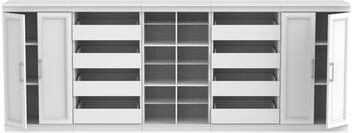
ClosetMaid Modular Storage 106.97-inch Wide Multi-Functional Organizer with DoorsDecorative trim, molding, and full back panels give each piece of ClosetMaid's Modular Storage collection a unique, boutique look, which when combined creates a vision of personalized organization you'll love to show off!835,06 $*Shipping: 0,00 $Secure redirect to the provider


-
How are extinction coefficients calculated?
Extinction coefficients are calculated by measuring the absorbance of a substance at a specific wavelength using a spectrophotometer. The absorbance value is then used in the Beer-Lambert law equation, A = εlc, where A is the absorbance, ε is the extinction coefficient, l is the path length of the sample, and c is the concentration of the substance. By rearranging the equation, the extinction coefficient (ε) can be calculated by dividing the absorbance (A) by the product of the path length (l) and concentration (c) of the substance. **
-
How do you determine the coefficients?
The coefficients in a mathematical equation are determined through a process called regression analysis. This involves using statistical techniques to find the best-fitting line or curve that represents the relationship between the variables in the equation. The coefficients are then calculated based on the data points and the specific regression model being used, such as linear regression or polynomial regression. The goal is to find the coefficients that minimize the difference between the predicted values from the model and the actual observed values in the data. **
-
How do I determine the coefficients?
To determine the coefficients in a mathematical equation, you can use various methods depending on the type of equation. For linear equations, you can use the method of substitution or elimination to solve for the coefficients. For quadratic equations, you can use the method of completing the square or the quadratic formula to find the coefficients. In general, you can also use regression analysis or curve fitting techniques to determine the coefficients in a more complex equation. **
-
How do you calculate the extinction coefficients?
The extinction coefficient, also known as molar absorptivity, is calculated using the Beer-Lambert law, which relates the absorbance of a substance to its concentration and the path length of the sample. The formula for calculating the extinction coefficient is ε = A / (c * l), where ε is the extinction coefficient, A is the absorbance, c is the concentration, and l is the path length. By measuring the absorbance of a known concentration of the substance at a specific path length, the extinction coefficient can be determined. This value is important for quantifying the concentration of a substance in a solution using spectrophotometry. **


What is the problem with the coefficients?
The problem with the coefficients is that they can be sensitive to the scale of the input variables. This means that if the input variables are on different scales, the coefficients may not accurately represent the true relationship between the variables and the target. Additionally, coefficients can be difficult to interpret when the input variables are not standardized, making it challenging to compare the impact of different variables on the target. Standardizing the input variables can help address these issues by putting them on the same scale and making the coefficients more interpretable and comparable. **
How do you get to the coefficients here?
To get the coefficients in a linear regression model, we use a method called ordinary least squares (OLS). This method minimizes the sum of the squared differences between the observed values and the values predicted by the model. By minimizing this sum, we can find the coefficients that best fit the data. The coefficients represent the relationship between the independent variables and the dependent variable in the model. **
Top-Angebote
Products related to Coefficients:
-
Housely Modern Velvet Modular L-Shaped Sectional - Compact Deep-Seat SofaCreate a cozy, style-forward seating area with this modern 3-piece corner sectional sofa. Designed in a space-smart L-shaped layout, this modular set delivers the ideal mix of comfort, function, and contemporary appeal.1672,49 $*Shipping: 0,00 $Secure redirect to the provider
-
Smart Shopping Spot Compact Car Safety Hammer Multi Functional Vehicle Escape Tool With Window Breaker Compact Car Safety Hammer Multi Functional Vehicle Escape Tool With Window BreakerEvery second counts in a car emergency. The car safety hammer is designed for drivers, passengers, and families who want to feel secure on the road. Lightweight yet powerful, this vehicle escape tool shatters windows, cuts seatbelts, and provides...34,97 $*Shipping: 0,00 $Secure redirect to the provider
-
ClosetMaid Modular Storage 106.97-inch Wide Multi-Functional Organizer with DoorsDecorative trim, molding, and full back panels give each piece of ClosetMaid's Modular Storage collection a unique, boutique look, which when combined creates a vision of personalized organization you'll love to show off!796,49 $*Shipping: 0,00 $Secure redirect to the provider
-
Discount Dollar Deals Rotating Multi Functional Plastic Compact Home Hanger Rack Holder For Adjustable Belt Scarf Tie Rotating Multi Functional Plastic Compact Home Hanger Rack Holder For Adjustable Belt Scarf TieEfficient SpaceSaving Solution The Rotating MultiFunctional Plastic Compact Home Hanger is the ultimate spacesaving tool for your home. Whether you're organizing scarves, belts, ties, or accessories, this hanger is designed to keep everything neat...34,97 $*Shipping: 0,00 $Secure redirect to the provider
-
What are math coefficients?
Math coefficients are the numerical factors that are multiplied by variables in algebraic expressions or equations. They represent the scale or magnitude of the variable in the expression. For example, in the expression 3x + 5, the coefficient of x is 3. Coefficients are important in understanding the behavior and relationships between variables in mathematical equations and expressions. **
-
What are coefficients in chemistry?
In chemistry, coefficients are the numbers placed in front of chemical formulas in a balanced chemical equation. These coefficients represent the ratio of moles of each substance involved in the reaction. Coefficients are used to balance chemical equations by ensuring that the number of atoms of each element is the same on both sides of the equation. They help in determining the stoichiometry of a reaction, which is the quantitative relationship between reactants and products in a chemical reaction. **
-
How are extinction coefficients calculated?
Extinction coefficients are calculated by measuring the absorbance of a substance at a specific wavelength using a spectrophotometer. The absorbance value is then used in the Beer-Lambert law equation, A = εlc, where A is the absorbance, ε is the extinction coefficient, l is the path length of the sample, and c is the concentration of the substance. By rearranging the equation, the extinction coefficient (ε) can be calculated by dividing the absorbance (A) by the product of the path length (l) and concentration (c) of the substance. **
-
How do you determine the coefficients?
The coefficients in a mathematical equation are determined through a process called regression analysis. This involves using statistical techniques to find the best-fitting line or curve that represents the relationship between the variables in the equation. The coefficients are then calculated based on the data points and the specific regression model being used, such as linear regression or polynomial regression. The goal is to find the coefficients that minimize the difference between the predicted values from the model and the actual observed values in the data. **
Similar search terms for Coefficients
-
Inspire Curations Horizontal Modular Utility Storage Pack Compact Gear Organizer Pouch blackKeep small essentials organized, accessible, and ready whenever you need them. This modular utility pouch features a practical horizontal profile designed for storing everyday tools, accessories, and compact gear without unnecessary bulk. Its...80,50 $*Shipping: 0,00 $Secure redirect to the provider
-
ClosetMaid Modular Storage 106.97-inch Wide Multi-Functional Organizer with DoorsDecorative trim, molding, and full back panels give each piece of ClosetMaid's Modular Storage collection a unique, boutique look, which when combined creates a vision of personalized organization you'll love to show off!835,06 $*Shipping: 0,00 $Secure redirect to the provider
-
Inspire Curations Horizontal Modular Utility Storage Pack Compact Gear Organizer Pouch greenKeep small essentials organized, accessible, and ready whenever you need them. This modular utility pouch features a practical horizontal profile designed for storing everyday tools, accessories, and compact gear without unnecessary bulk. Its...85,00 $*Shipping: 0,00 $Secure redirect to the provider
-
Inspire Curations Horizontal Modular Utility Storage Pack Compact Gear Organizer Pouch cpKeep small essentials organized, accessible, and ready whenever you need them. This modular utility pouch features a practical horizontal profile designed for storing everyday tools, accessories, and compact gear without unnecessary bulk. Its...80,50 $*Shipping: 0,00 $Secure redirect to the provider
-
How do I determine the coefficients?
To determine the coefficients in a mathematical equation, you can use various methods depending on the type of equation. For linear equations, you can use the method of substitution or elimination to solve for the coefficients. For quadratic equations, you can use the method of completing the square or the quadratic formula to find the coefficients. In general, you can also use regression analysis or curve fitting techniques to determine the coefficients in a more complex equation. **
-
How do you calculate the extinction coefficients?
The extinction coefficient, also known as molar absorptivity, is calculated using the Beer-Lambert law, which relates the absorbance of a substance to its concentration and the path length of the sample. The formula for calculating the extinction coefficient is ε = A / (c * l), where ε is the extinction coefficient, A is the absorbance, c is the concentration, and l is the path length. By measuring the absorbance of a known concentration of the substance at a specific path length, the extinction coefficient can be determined. This value is important for quantifying the concentration of a substance in a solution using spectrophotometry. **
-
What is the problem with the coefficients?
The problem with the coefficients is that they can be sensitive to the scale of the input variables. This means that if the input variables are on different scales, the coefficients may not accurately represent the true relationship between the variables and the target. Additionally, coefficients can be difficult to interpret when the input variables are not standardized, making it challenging to compare the impact of different variables on the target. Standardizing the input variables can help address these issues by putting them on the same scale and making the coefficients more interpretable and comparable. **
-
How do you get to the coefficients here?
To get the coefficients in a linear regression model, we use a method called ordinary least squares (OLS). This method minimizes the sum of the squared differences between the observed values and the values predicted by the model. By minimizing this sum, we can find the coefficients that best fit the data. The coefficients represent the relationship between the independent variables and the dependent variable in the model. **
* All prices are inclusive of VAT and, if applicable, plus shipping costs. The offer information is based on the details provided by the respective shop and is updated through automated processes. Real-time updates do not occur, so deviations can occur in individual cases. ** Note: Parts of this content were created by AI.